
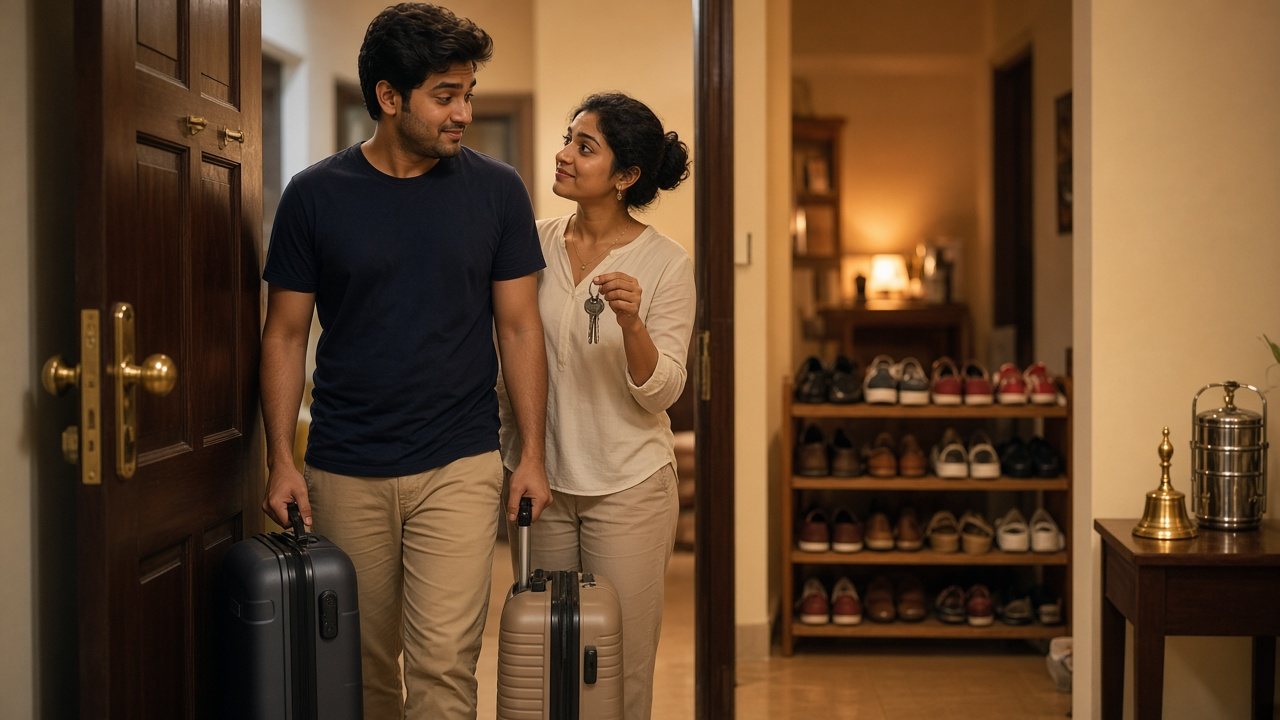
Third call. Things are going well.
He likes old Kishore songs. You like old Kishore songs. He hates pineapple on pizza. So do you.
Then he says it, very casually: “Oh, and after marriage we’ll stay with Mummy-Papa. Obviously.”
Obviously. The word sits there like an uninvited mausi at a sangeet.
If you’re wondering whether to live with parents after marriage, or whether to marry someone who simply won’t move out, this one’s for you. We’ll cover the honest pros, the brutal cons, the questions to ask and the red flags you should never ignore in an arranged marriage version of this talk. No lectures. Just clarity.
Why So Many Indians Want to Live With Parents After Marriage
First, let’s drop the villain music. Wanting to stay with parents is not automatically a “mumma’s boy” or “papa’s girl” thing.
The reasons are often very real:
- Only child duty. No siblings means nobody else to take Papa for his BP check-up.
- Ageing or unwell parents. Some people simply can’t leave a parent alone.
- Money. City rents are wild. A paid-off family flat is hard to ignore.
- Culture and habit. In many families, this is just how it has always been.
- Love. Some people genuinely enjoy home-cooked dinners and Sunday chaos.
The trouble is rarely the reason. It’s the “obviously”. The assumption that you’ll fit in, adjust, and maybe also talk about career expectations before marriage only after the rules are already set.
A plan made for you is not a plan made with you.
The Honest Pros (Yes, There Are Real Ones)
Living with in-laws gets a bad name on Instagram reels. But it has upsides that nobody films.
- You save serious money. No rent, shared bills, and maybe a bigger down payment later.
- Built-in support. Fever at 2 am? Someone is awake. Courier at noon? Someone is home.
- Help with kids. Grandparents are the original premium daycare. With extra ghee.
- Less loneliness. Big families mean noise, food and stories. Some people thrive on that.
✅ Green flag: when they talk about living together, they say “we” and “our home”, not “my house, my rules”.
Meet Kavya. 28. Moved into her husband’s family flat in Pune. Her saas makes the best poha in Maharashtra and her sasur fixes her laptop. She calls it “a hostel with love”. It works because everyone agreed on the rules before the wedding.
The Brutal Cons Nobody Puts in the Biodata
Now the other side. Because the biodata says “family-oriented”, not “family-supervised”.
- Zero privacy. A closed door can start a 20-minute discussion.
- Two bosses in one kitchen. Whose way of making dal wins? Spoiler: not yours, at first.
- Unequal load. One spouse quietly does the adjusting, the cooking and the “beta, chai bana do”.
- Slow couple bonding. Hard to build your own inside jokes when Chachaji is on the next sofa.
- Fights become family events. A small argument gets an audience and three opinions.
Many couples say the first few months feel like living in someone else’s home with a new roommate you married. That’s why so many cling to their two weeks at honeymoon places in India like it’s oxygen.
None of this means it can’t work. It means it needs a plan.
Green Flags vs Red Flags in a Partner Who Wants to Stay With Parents
The question isn’t “joint or separate”. The question is “how will this person act when things get awkward?”
| ✅ Green flag | 🚩 Red flag |
|---|---|
| Explains why they want to stay | Says “that’s just how it is” |
| Asks what you need to feel at home | Expects you to “adjust, na” |
| Open to a review after a year | Treats it as permanent and non-negotiable |
| Will speak up for you with family | Goes silent when Mummy disagrees |
| Shares chores without being asked | Hasn’t made their own bed since 2009 |
Notice something? Almost every green flag is also one of the signs someone is genuinely serious about marriage. Seriousness shows up as effort, not adjectives.
6 Questions to Ask Before You Say Yes
Don’t ask “Will I get freedom?” It sounds like a hostel admission. Ask about everyday life instead.
1. Is This Forever or for a Phase?
“Are we living with your parents for the long run, or for a few years?” Both answers are fine. Not knowing is not.
2. Will We Have Our Own Room, Space and Time?
A room with a lock. A weekend plan that’s just the two of you. These sound small. They’re not.
3. Who Runs the Kitchen and the Chores?
Ask who cooks, who cleans, and whether there’s help. Then ask how he or she pitches in today.
What to say instead of a hint: “How do chores work at home right now? Who does what?”
4. How Will Money Work?
Will you contribute to household costs? Who pays for what? Is there a family pool? These belong in your list of money questions to ask before marriage, not your first anniversary.
5. What Happens When We Disagree With Your Parents?
This is the big one. Ask for a real example. “Last time you disagreed with your mom, what happened?”
If the answer is “I never disagree with her”, sit with that for a bit.
6. Is There Any Room to Move Out Later?
Jobs change. Cities change. Kids arrive. Ask if a separate flat, even nearby, is ever on the table. For the full side-by-side, here’s what to discuss about joint vs nuclear family living.
For some people, this is as big a deal-breaker as a partner who doesn’t want children. Know which camp you’re in before the rishta gets serious.
Pro tip: ask the same question to the parents too, gently. “How do you picture the first year after the wedding?” Their answer is pure gold.
What If You Want Your Own Space?
Wanting your own home is not selfish. It’s a preference. Same as theirs.
Say it early and kindly. Try this:
“I really respect how close you are to your family. I’d love us to be close to them too. I also want our own home at some point, even nearby. Can we talk about how that might look?”
No ultimatum. No drama. Just your truth, on the table.
Middle paths exist too:
- Same building, different flat. Close enough for Sunday lunch. Far enough for Saturday lie-ins.
- Live together for a fixed time. One or two years, then review honestly.
- Your own floor or wing. Shared house, separate kitchen. Basically a peace treaty with a staircase.
- Protect couple time. Plan a few trips a year. Even a list of romantic international getaways for couples on the fridge is a statement.
So, Would You Marry Someone Who Wants to Live With Their Parents?
Here’s the honest answer: it depends less on the house and more on the person.
A partner who listens, shares chores, sets fair boundaries and stands next to you? You can make a joint home work. Many couples do, happily.
A partner who says “adjust” and goes quiet whenever Mummy frowns? Even a 4BHK will feel small.
Take your time. Meet more than once, ideally at their home. Notice who serves the chai and who sits. If you’re unsure how many chats it takes, here’s how many meetings you need before saying yes.
Your answer can be yes, no, or “yes, with a plan”. All three are allowed.
Keep Reading
- The Biggest Mistake People Make on Their Matrimony Profile
- How Much Age Difference Is TOO Much in Marriage?
- What Should Your First Message on a Matrimony App Actually Say?
Quick Takeaway
- Wanting to live with parents after marriage isn’t a red flag by itself. The “obviously” is.
- Ask if it’s forever or a phase, and how privacy, chores and money will work.
- Watch how they handle disagreements with their parents. That’s your real answer.
- Wanting your own space is a fair preference. Say it early, kindly and clearly.
- Middle paths exist: same building, fixed time, separate floor.
FAQs
Is it okay to live with parents after marriage?
Yes, if both partners agree on it openly. Many couples live with parents happily when privacy, chores, money and boundaries are discussed before the wedding. It goes wrong when one person assumes and the other just adjusts.
Should I marry someone who wants to live with their parents?
It depends on the person more than the house. If they listen, share chores and will speak up for you with family, it can work well. If they expect you to adjust silently, take that seriously.
What should I ask before agreeing to live with in-laws?
Ask whether it is permanent or for a phase, whether you will have your own room and couple time, who runs the kitchen, how money will work, and what happens when you disagree with the parents.
Is wanting a separate home after marriage selfish?
No. It is a preference, just like wanting to stay with parents is a preference. Say it early and kindly, and look at middle paths like a flat in the same building or a fixed time living together.
Can we move out later if living with parents doesn’t work?
Only if you discuss it before marriage. Agree on a review point, such as one or two years, so moving out later feels like a shared plan instead of a betrayal.
A home isn’t about whose name is on the nameplate. It’s about whether both of you feel at home inside it.
Ask the awkward questions now. They’re much cheaper than the awkward years.
Know someone whose match just said “we’ll stay with Mummy-Papa, obviously”? Send them this. And tell us in the comments: joint home, own home, or “yes, with a plan”?
Joint Family vs Nuclear Family: Discuss THIS Before Marriage
October 23, 2026 at 9:21 am[…] how loudly you can watch Netflix at midnight. If you’ve already wondered whether you’d marry someone who wants to live with their parents, this post goes one step further. You’ll get the five things to discuss before marriage, plus […]
Add a comment