
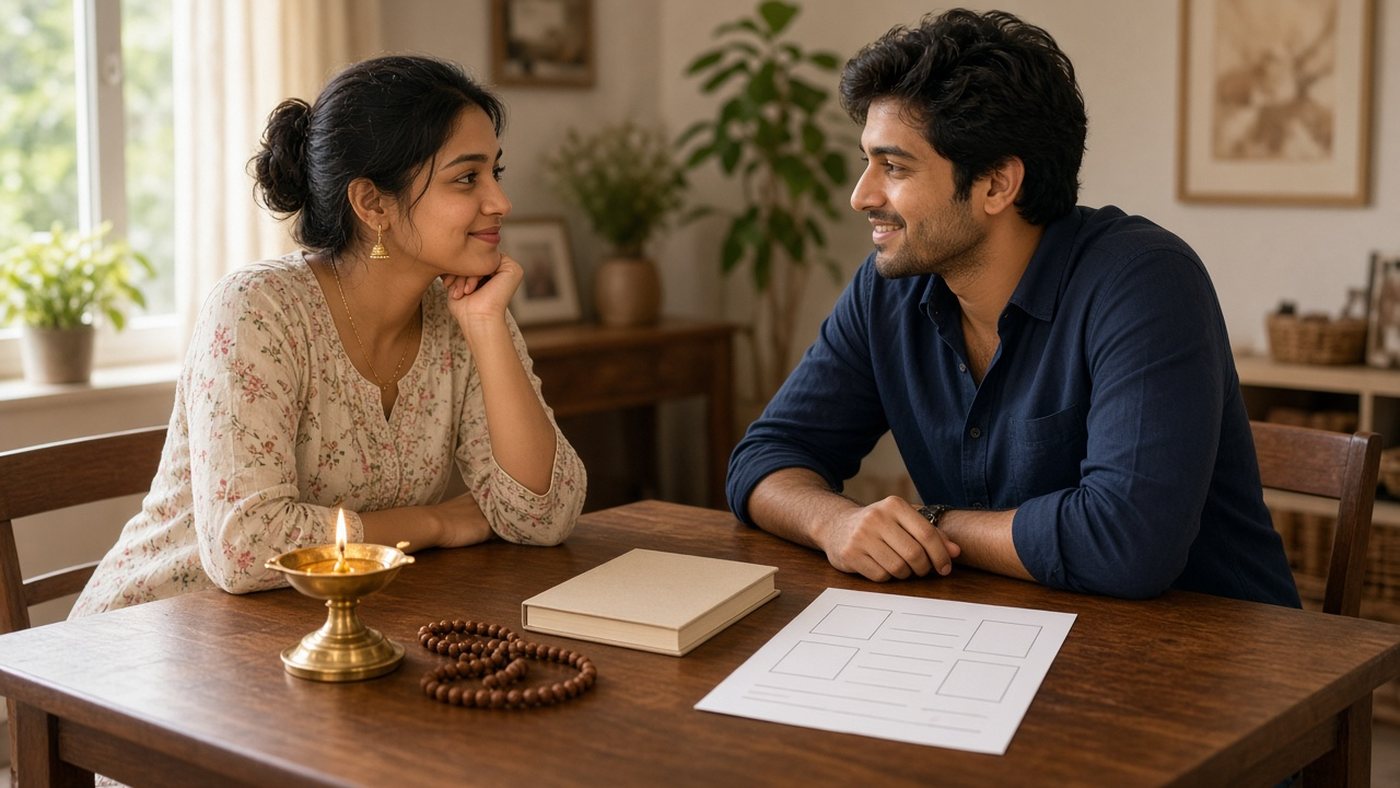
The biodata arrives at 11:07 pm. Mom forwards it with one line: “Same religion. Very cultured family.”
You skim the photo. Then the education. Then the city. Religion is already ticked for you.
But nobody asked if it should be.
If you’re stuck on religion choosing partner decisions, this post helps you sort what is sacred for you, what is family pressure, and what you can actually live with. It sits next to the same honest filter talk as whether caste still matters to millennials.
How Important Should Religion Be? The Honest Short Answer
As important as you need it to be for a peaceful home. No more. No less.
For some people, faith is the spine of the week. Prayer, fasting, festivals, kids’ upbringing. For others, religion is a festival outfit and a family WhatsApp forward.
Both are valid. Pretending they are the same is not.
So the real question is not “Is religion important?” It is “How central is faith to the life I want to build?”
If the answer is “very”, treat it as a serious filter. If the answer is “nice to have”, leave room for a match who believes differently but treats your beliefs with respect. The same honesty shows up when people ask if they would marry outside your caste if compatibility was perfect.
Pro tip: Write your own answer before you open the next biodata. Deciding under family pressure usually means deciding for someone else.
Where Religion Shows Up in Arranged Marriage (Even When Nobody Says It)
Apps hide it behind a dropdown. Families rarely do.
Religion sneaks into the process in quiet places.
- The first filter. Many profiles never leave the “same religion” box.
- The surname scan. Relatives guess community before they read the bio.
- Festival talk. “What do you do for Diwali / Eid / Christmas / Gurpurab?” is a values check, not small talk.
- Food rules. Fasting days, temple food, meat at home. Faith and plate travel together. See also food habits that turn into future problems.
- The wedding itself. Whose rituals, whose priest or maulvi or granthi, whose songs. Plan early with a solid traditional wedding songs and dances shortlist if families want both cultures on stage.
Meet Kabir. 29. Soft believer. Goes to the gurdwara when he can.
His parents want “same religion, same values.” What they mean is: same festivals, same kitchen rules, same comfort zone at the wedding.
Kabir means: someone who won’t mock his faith and won’t force him into three hours of ritual every morning.
Same word. Different dictionary.
Same Faith, Different Practice: The Quiet Gap
Here is the sneaky part of religion choosing partner talks.
Two people can share a religion and still fight about it every Sunday.
One wants morning prayer. The other wants morning gym. One wants kids in a faith school. The other wants a regular school and festivals at home. One is fine with interfaith friends. The other is not.
Label match is not practice match.
That is why faith belongs on the list of uncomfortable questions every couple should discuss. Ask how they live it. Not only what they tick on a form.
✅ Green flag: Your match can explain their faith without putting yours down. Curiosity beats conversion energy.
🚩 Red flag: “After marriage you’ll understand our way.” That is a preview, not a joke.
Religion Choosing Partner: A 5-Question Check for Yourself
Before you argue with Mom, argue with a notebook.
- Would I feel at peace if my kids grew up with a different faith practice than mine? Be honest. Not Instagram honest.
- Do I need shared rituals at home, or shared respect is enough?
- Can I handle festival logistics with two families? Two calendars. Two sets of relatives. Two opinions on the wedding menu.
- Am I okay if my partner is less religious than me? Or more? Intensity gaps break more homes than labels.
- If my family never softens, can I still choose this person? If the answer is no, admit it early.
Your answers are your boundary. Not your auntie’s. Not your college friend’s hot take.
How to Talk About Faith Without Starting a Family War
Do not open with a speech. Open with a question.
What to say to your match:
- “How big a part does faith play in your normal week?”
- “What would religion look like in our home if we got married?”
- “Are there practices that are non-negotiable for you?”
What to say at home:
- “I hear why same religion feels safer. Can we also talk about values and kindness?”
- “I’m not rejecting our faith. I’m choosing a partner who respects it.”
- “Let’s meet them once before we decide from a PDF.”
If the room explodes anyway, you are not alone. Use the same calm steps as when your family says no to the match. Facts first. Fear second. Ego last.
And please: do not “soft launch” an interfaith match for six months and hope relatives will clap at the reception. Surprise is not a strategy.
When Religion Really Is a Deal-Breaker (And When It Isn’t)
It is often a deal-breaker when:
- Faith is the centre of your identity, and your match dismisses it.
- One side expects conversion. The other never agreed.
- Kids’ upbringing is a hard conflict with no middle path.
- Living with either family means daily pressure to hide who you are.
It may not be, when:
- Both of you are loosely practising and share values.
- You can agree on festivals, food, and kids before saying yes.
- Families are open, or you will live independently with clear boundaries.
Wedding logistics get real fast. If ceremonies from two traditions are on the table, build them into your Indian wedding planning checklist early. Same for food. Mixed faith homes often hit the same kitchen talks as marrying across veg and non-veg lines.
There is no universal score. There is only the home you two can keep without resentment.
Keep Reading
- Would You Marry Someone From Another State?
- Joint Family vs Nuclear Family — Discuss THIS Before Marriage
- Parents Like the Match, but You Don’t — What Should You Do?
Quick Takeaway
- Religion choosing partner weight is personal. Decide your line before the next rishta call.
- Same label ≠ same practice. Ask how faith shows up on a normal Tuesday.
- Talk early with your match and your family. Silence creates bigger fights.
- Conversion pressure, kids’ conflict, and daily disrespect are hard stop signs.
- Your choice. Your home. Your peace.
FAQs
Should religion matter when choosing a life partner?
It can matter a lot, a little, or almost not at all. That depends on how central faith is to your daily life, your family, and your idea of home. Decide your own line first. Then see if your match shares it.
Is interfaith marriage hard in India?
It can be harder with families, paperwork, and festival logistics. Couples who do well talk early about kids, rituals, and where they will live. The hard part is usually silence, not the wedding day itself.
What if my family wants same religion but I don’t mind different?
Be honest early. Hidden plans create bigger fights later. Share why faith is or isn’t a filter for you, listen to their fears, and decide together what you can live with. Forcing either side rarely works.
How do I ask a match about religion without sounding rude?
Ask with curiosity. Try: How big a part does faith play in your week? Or: What festivals does your family celebrate at home? Skip quizzes. Listen more than you lecture.
Does same religion guarantee a happy marriage?
No. Same label, different practice is common. Kindness, money talks, living setup, and respect for each other’s boundaries matter more than matching biodata fields alone.
Faith can be a bridge or a wall. You get to choose which. The same honest filter talk shows up when a kundali matches perfectly but personalities don’t. If this helped, send it to that friend stuck between a biodata filter and their own heart. And drop your take in the comments. Kind ones only.
Add a comment