
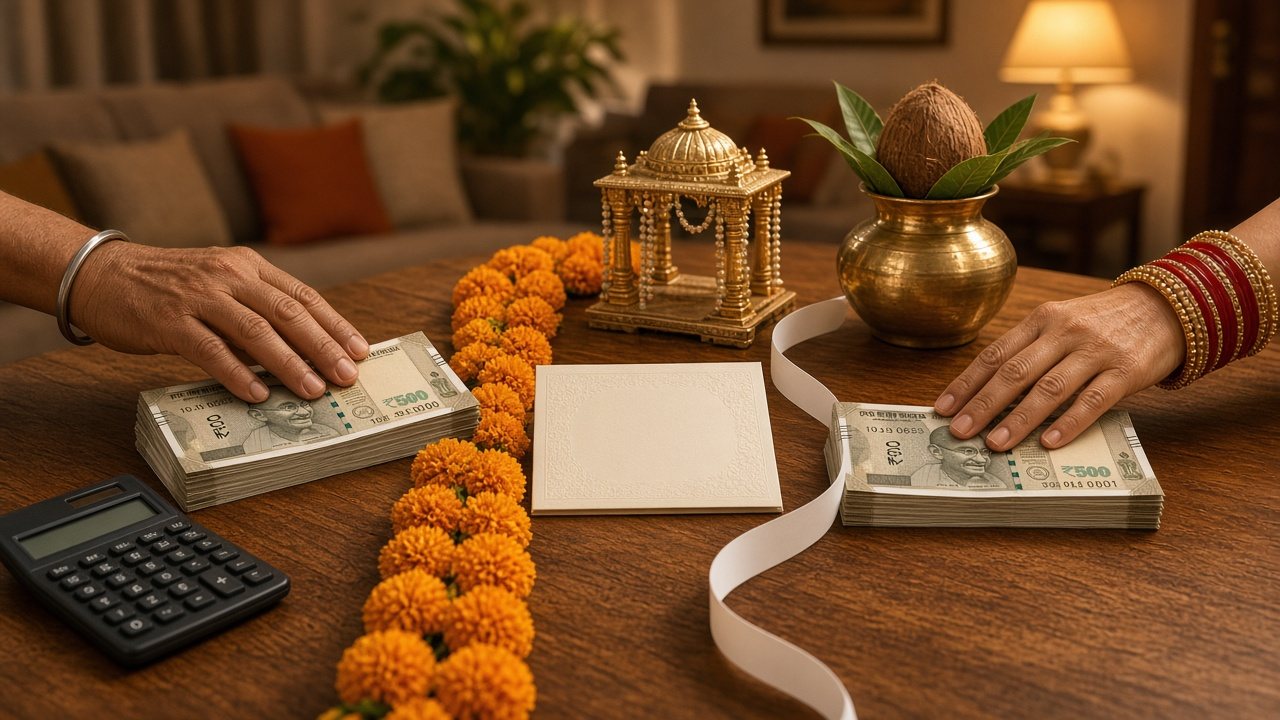
The rishta is fixed. The ladoos are distributed. Everyone is smiling.
Then someone asks, “So… who’s booking the banquet hall?”
Silence. Three uncles suddenly need to take a phone call.
Should you split wedding expenses between both families? It’s the question every Indian wedding avoids until the caterer’s advance invoice arrives. You already know the five money questions to ask before marriage. This one is about the wedding itself. You’ll get the honest answer, four ways families actually share the bill, and scripts for saying it out loud without anyone sulking at the sangeet.
Who Pays for an Indian Wedding? The Old Rulebook
For generations, the unwritten rule was simple.
The girl’s family pays for almost everything. The boy’s family arrives, dances, eats, and comments on the paneer.
Some families still follow this. Many follow it without ever saying it out loud, which is worse.
The old rulebook came from a time when the bride’s parents “gave” her away and the wedding was their big show. Times changed. The rulebook mostly didn’t.
Meet Ananya. 28. Software engineer. Her parents took a personal loan for a five-function wedding. Her in-laws added 200 guests in the last week. Nobody asked who was paying for their plates.
Funny at a party. Not funny on the EMI statement.
Why Splitting Wedding Expenses Makes Sense Now
Here’s our clear stance: yes, wedding expenses should be split in some fair way. Not always 50-50. But never “one side pays, the other side orders.”
Why it works better today:
- Both sides want a say. If you choose the menu, the venue and the guest list, you share the bill. Simple.
- Both partners often earn. Many couples now chip in themselves, so the “girl’s side” idea is already blurred.
- It protects the marriage. Resentment from a lopsided wedding doesn’t leave with the tent house. It shows up at every Diwali.
- It’s a test run. How two families handle one big shared bill tells you a lot about the next forty years.
Awkward for ten minutes beats bitter for ten years.
4 Ways Families Actually Split the Bill
There’s no single right formula. Pick the one that fits your families, and write it down. Pair it with an honest wedding planning checklist so nothing slips through the cracks.
1. The Straight 50-50
Verdict: cleanest, if budgets are similar.
Add up every shared cost and halve it. Venue, catering, decor, photographer, all of it.
Works beautifully when both families earn in the same range. Gets tense when one side’s “small function” means 150 people and the other side’s means 600.
2. Split by Event
Verdict: the most popular middle path.
Each family hosts and pays for its own functions. Bride’s side takes the mehndi and haldi. Groom’s side takes the reception. The wedding day is shared.
Bonus: each family controls its own guest list and its own playlist. Fewer fights about whether Chacha’s DJ friend gets a slot.
3. Split by Guest Count
Verdict: the fairest for mismatched guest lists.
Fixed costs like the venue and decor get split equally. Per-plate costs get split by how many guests each side invites.
Invite 400 people? Pay for 400 plates. It’s maths, not an insult.
4. The Couple Pays Too
Verdict: the modern game-changer.
The couple covers a fixed chunk, say their outfits, the photographer or the honeymoon. Parents split the rest.
This gives the couple a real voice. It also stops anyone from saying, “Our money, our rules.”
| Method | Best For | Watch Out For |
|---|---|---|
| 50-50 | Similar budgets | Unequal guest lists |
| By event | Families who like control | One side’s event getting fancier |
| By guest count | Big guest list gaps | Arguments over who “counts” |
| Couple chips in | Earning couples | Draining your savings |
When a “Fair” Split Isn’t Fair
Equal isn’t always fair. Sometimes one family simply has more money.
A 50-50 split can crush a family that earns half as much. It can push them into loans, or into silently cutting corners and feeling small.
In that case, a proportional split works better. The family that can give more gives more, and nobody keeps score in public.
This is also where family setup matters. If one side lives as a big joint household, the guest list and the costs grow fast. That’s part of the joint family vs nuclear family debate nobody warns you about.
And please, don’t fund a dream wedding with a mountain of debt. Starting married life under a pile of loans is a terrible wedding gift to yourselves.
Pro tip: Before the families talk, the couple should share your complete financial situation with each other. You can’t plan a fair split if you don’t know what you can each actually afford.
How to Bring Up the Wedding Budget Without a Cold War
The hardest part isn’t the maths. It’s the first sentence.
Start with the couple. Agree between the two of you first. It’s one of those uncomfortable questions every couple should discuss, and it’s easier with tea than with twelve relatives on speaker.
Then bring it to the families together, ideally in person, ideally with snacks.
What to say instead of hinting:
- “We want both families to feel equally involved. Can we decide together how to share the costs?”
- “We were thinking each side hosts its own functions and we split the main day. What do you feel?”
- “We’re putting in some money too, so let’s agree on a total budget first.”
What NOT to say: “Your side invited half of Ludhiana, so you pay.” True, maybe. Helpful, never.
Fix the total budget before anyone books anything. Overspending on a whim is one of the most common wedding planning mistakes, and it’s twice as painful when two families share the damage.
Then put it in a shared spreadsheet. Boring? Yes. Fight-proof? Mostly.
Red Flags in the Money Talk
Most families are lovely about this once the topic is open. Some are not.
🚩 Red flag: One side refuses to discuss costs but keeps adding demands. “We’ll need a bigger venue. And a band. And gold coins for our guests.”
Watch for these:
- Demands for cash, cars or gifts “as per tradition.” That’s dowry. It’s illegal in India, and it’s a dealbreaker.
- Guilt-tripping: “In our family, the girl’s side always takes care of everything.”
- Your partner going silent while their parents push.
- Last-minute changes that conveniently cost the other side more.
That third one matters most. A partner who won’t speak up now probably won’t speak up later. Add it to your list of red flags you should never ignore.
✅ Green flag: Your partner says, “Let’s figure out what’s fair for both families,” and then actually does it.
Keep Reading
- Is Owning a House Really Important Before Getting Married?
- ₹10 LPA vs ₹30 LPA — Does Income Really Decide Matrimony Success?
- Would You Marry Someone With a Much Lower Salary Than You?
Quick Takeaway
- Yes, split wedding expenses fairly. Fair doesn’t always mean 50-50.
- Pick a method: 50-50, by event, by guest count, or the couple chips in.
- Agree as a couple first, then fix a total budget with both families.
- Never take on heavy debt for one day of celebration.
- Any demand for cash, cars or gifts is dowry, and it’s a dealbreaker.
FAQs
Who traditionally pays for an Indian wedding?
Traditionally, the bride’s family paid for most of the wedding. Today many families split the costs, host their own functions, or have the couple contribute too.
Is it fair to split wedding expenses 50-50?
It’s fair when both families have similar budgets and guest lists. If one side invites far more people or earns much less, a split by guest count or by ability to pay is often fairer.
How do we bring up splitting wedding costs with the in-laws?
Agree as a couple first, then raise it together in person. Frame it as wanting both families equally involved, and suggest a method instead of making demands.
Should the couple pay for their own wedding?
If you both earn, chipping in for a fixed part like outfits, photography or the honeymoon is a great idea. Just don’t empty your savings or take big loans for one day.
What if the groom’s family expects the bride’s side to pay for everything?
Talk about it calmly and early, with your partner on your side. If the expectation turns into demands for cash, cars or gifts, that’s dowry, which is illegal in India and a serious red flag.
The best weddings aren’t the most expensive ones. They’re the ones where both families still like each other at the vidaai.
Know a couple about to have “the budget talk”? Send this their way. And tell us in the comments: how did your families split the bill?
Ultimate Wedding Planning Checklist for Indian Weddings
October 26, 2026 at 6:23 pm[…] Set a budget, and agree early on how both families will split wedding costs […]
Add a comment