
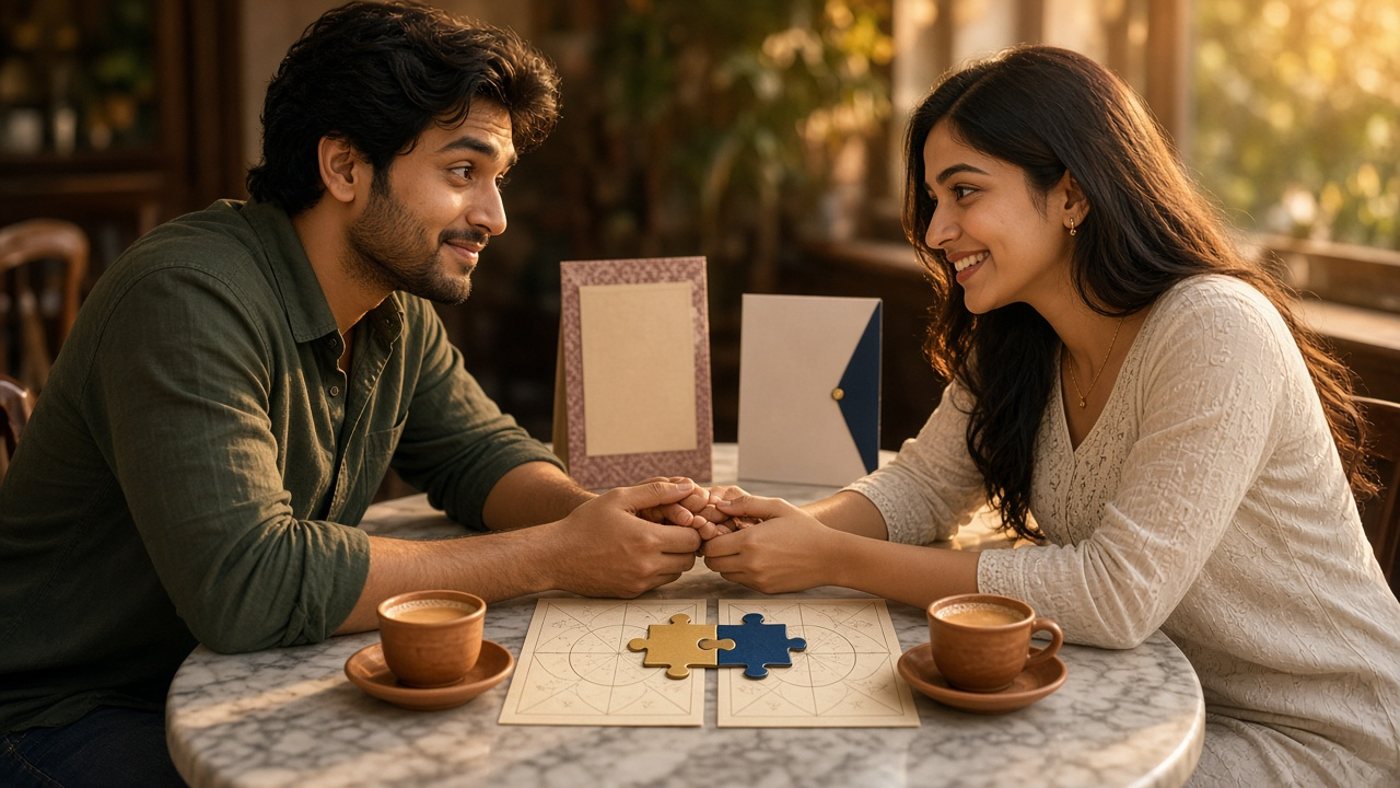
Meet Aditi. 28. Product designer in Bengaluru.
She finally found him. Funny. Kind. Hates loud weddings as much as she does. Even laughs at her bad puns.
Then Mummy asks the one question that wipes the smile off the whole family WhatsApp group: “Beta, kaunsi caste?”
So here’s the big one. Would you marry outside your caste if compatibility was perfect? In this post you get an honest look at what “perfect” really means, why caste still pops up in rishta talks, and how to handle things when your family says no to someone you like. No lectures. Just real talk.
First, What Does “Perfect Compatibility” Actually Mean?
Let’s be honest. “Perfect” doesn’t exist. Even your favourite Bollywood couple fights over the AC remote.
But “very compatible” does exist. It usually looks like this:
- You want the same things: kids, city, career pace, money habits.
- You argue without insulting each other.
- You both show the signs someone is genuinely serious about marriage, not just “exploring options”.
- Your families could, at least in theory, share a plate of samosas without a cold war.
Notice what’s missing from that list? Surname. Gotra. Community.
Those can shape habits, sure. But they don’t tell you if someone will hold your hand in a hospital corridor at 2 am. The uncomfortable questions every couple should discuss tell you that.
Pro tip: Check compatibility on values first. Background is context, not a verdict.
Why Caste Still Comes Up in Rishta Talks
Many profiles now say “caste no bar”. Many families still quietly filter by it anyway. Both things are true at the same time.
Some of this is just habit. It is one of the classic biggest mistakes people make on a matrimony profile: writing “open-minded” in the bio while the filters say otherwise.
When families bring up caste, they’re often saying something else underneath. Here’s a quick decoder:
| What the family says | What it often means |
|---|---|
| “Log kya kahenge?” | We’re scared of relatives’ opinions. |
| “Their customs are different.” | We’re not sure our daughter or son will feel at home. |
| “Food habits won’t match.” | We worry about daily life, not just the wedding menu. |
| “We’ve always married within the community.” | Change feels unfamiliar, and unfamiliar feels risky. |
Some of these worries are fair. Some are just fear wearing a kurta. Your job is to tell them apart.
Would You Marry Outside Your Caste? Ask Yourself These 5 Honest Questions
Before you fight anyone, get clear with yourself. Take five quiet minutes. Chai optional, but recommended.
1. Is caste MY deal-breaker, or someone else’s?
Verdict: know whose rule you’re following. Plenty of people realise the rule was never theirs. They just never questioned it.
2. Can I live with some family friction?
Verdict: be realistic. Some families come around in weeks. Some take years. Some aunties never do, and that’s okay.
3. Do we agree on how to raise kids?
Verdict: this matters more than the wedding. Festivals, language, surname, religion at home. Talk about it now, not in the delivery room.
4. Will my partner stand with me in tough family moments?
Verdict: non-negotiable. An inter-caste marriage needs a team, not a spectator.
5. Am I choosing this person, or rebelling?
Verdict: choose the person. Marrying someone just to prove a point is a very expensive way to win an argument.
The Real Differences Worth Discussing
Here’s the surprising part. Most clashes in mixed-background marriages aren’t about caste at all. They’re about very ordinary, very daily stuff.
- Food: Veg, non-veg, onion-garlic rules, fasting days. Sort it before the first Diwali dinner.
- Rituals: Whose customs at the wedding? Whose at home? Both is a valid answer.
- Language: Will the kids grow up speaking two mother tongues? Lucky kids, honestly.
- Family setup: Have the joint family vs nuclear family talk early. It causes more drama than any surname.
The fun bit? Two traditions means double the celebrations. Pick from both sides’ traditional wedding songs and dances from different regions and suddenly your sangeet is the one everyone talks about.
✅ Green flag: Your partner is curious about your customs, not just tolerating them.
How to Bring Up an Inter-Caste Marriage at Home
Do not announce it at the dinner table between dal and the news. Timing is everything.
If you’ve ever handled a situation where parents love a match that you don’t, you already know the drill. Calm beats loud. Every time.
- Start with one ally. A sibling, a cool mausi, the cousin who married outside the community.
- Lead with the person, not the caste. Talk about who they are first.
- Answer the real worry. If it’s food or rituals, have a plan ready.
- Let them meet casually. A relaxed chai visit does more than ten arguments.
- Give it time. Your parents took decades to form these views. They won’t flip in one Sunday.
What to say instead of “It’s my life!”:
“Mummy, I know this isn’t what you imagined. I’m not asking you to agree today. I’m asking you to meet him once and see why I feel so sure.”
Soft words. Firm intent. That combo works more often than shouting.
So, Would You Marry Outside Your Caste?
Here’s our honest take. If compatibility is real (not a two-week crush, but tested), caste alone is a weak reason to walk away.
Legally, inter-caste marriage is completely valid in India. The bigger question is emotional: can you build a calm life while your family adjusts?
Take your time. Meet enough. Figure out how many meetings are enough before saying yes for you, and test the relationship under a little real-world pressure.
Then decide. Not your rishta aunty. Not the neighbours. You.
Your values, your future, your call.
Keep Reading
- Should You Meet Without Parents Before Involving Families?
- What Should You Talk About During Your First Arranged-Marriage Meeting?
- 7 Red Flags You Should NEVER Ignore in an Arranged Marriage
Quick Takeaway
- “Perfect” compatibility means shared values, goals and respect, not a matching surname.
- Decode the family’s worry: fear, food, rituals or relatives.
- Ask yourself the 5 honest questions before you fight anyone.
- Talk through food, rituals, kids and family setup early.
- Bring your family in slowly, with an ally and a casual meeting.
FAQs
Is inter-caste marriage legal in India?
Yes. Inter-caste marriage is completely legal in India. Couples can register it like any other marriage, and adults are free to choose their partner.
How do I convince my parents for an inter-caste marriage?
Start with one supportive family member, talk about the person before the caste, and answer the real worry, like food or rituals. Then arrange a relaxed meeting and give your parents time.
Does caste matter if compatibility is good?
For many couples, shared values, goals and respect matter far more than caste. Differences in food, rituals or language can be handled when both partners talk about them early.
What does caste no bar mean on a matrimony profile?
It means the person or family is open to matches from any caste. Check that their filters and conversations match the bio, because some profiles say it without meaning it.
What should we discuss before an inter-caste marriage?
Talk about food habits, festivals and rituals, how you will raise kids, language at home and the family setup. Also agree on how you will handle family pushback as a team.
Love doesn’t check gotra. Neither does a good marriage.
Know a friend whose bio says “caste no bar” but whose mom’s filter says otherwise? Send this their way. And tell us in the comments: would you do it?
Add a comment